How to Become a VPN Reseller With Zero Investment: The Complete Playbook
Learn how to start a VPN reseller business with zero upfront cost: how pin-based reselling works, unit economics, the technical side of censored networks, and market notes for China, Russia, Iran, Saudi Arabia, and the UAE.
Khan Muhammad Al Amin · September 24, 2026 · 14 min read
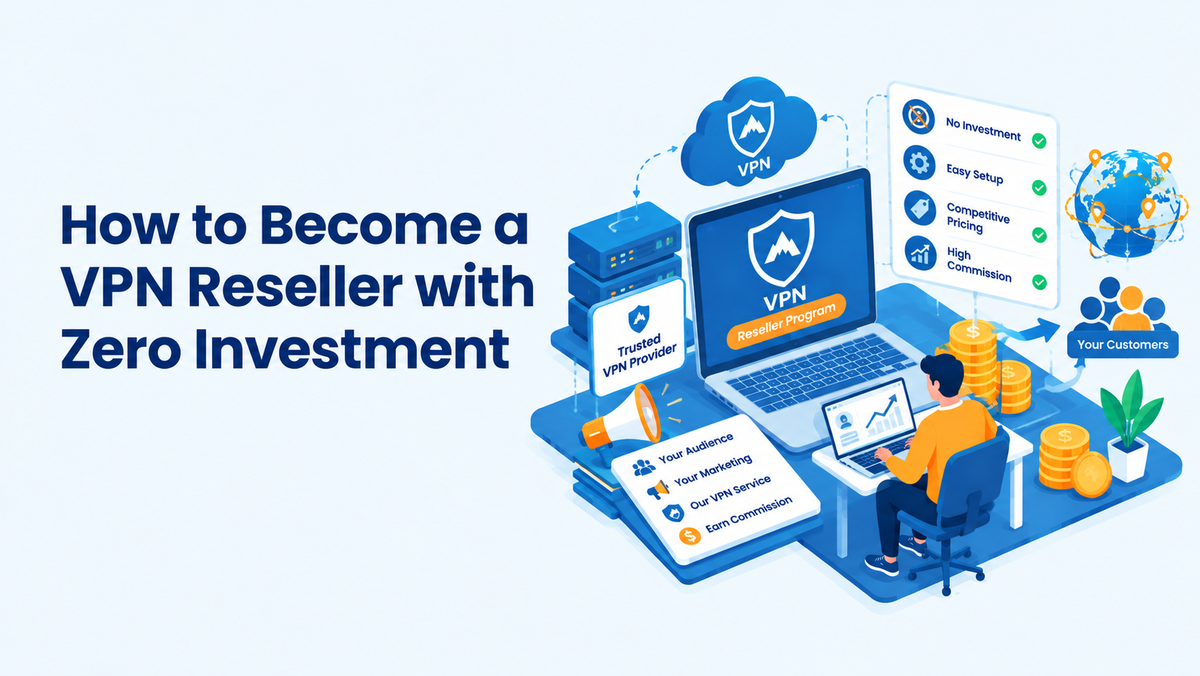
Most "start a business with no money" advice is fantasy. Reselling a VPN is one of the few models where it's close to real: there's no inventory, no servers to rent, no app to build and no software team to hire. You sell access to a service that already exists, and you keep the difference.
At EnovaVPN, we take this one step further. You receive activation pins to sell to your customers, and you pay us after you sell. This guide covers how that works, what the economics look like, and what you need to know to run it well in markets where internet censorship makes VPNs a daily necessity: China, Russia, Iran, Saudi Arabia and the UAE.
TL;DR
- A VPN reseller buys activation pins at wholesale, sells them at retail and keeps the margin.
- With Enova, you get pins through a dedicated reseller panel and settle after your sales, so no inventory is bought up front.
- Demand is strongest where censorship is heaviest, but so are legal and technical risks. Choose your market and your customers carefully.
- Your real "investment" is time, trust and support quality, not cash.
Reseller, affiliate or white label: which model fits?
People confuse these three, and picking the wrong one is the most common early mistake.
VPN Reseller
As a VPN reseller, you sell activation pins directly to customers. You own the customer relationship, giving you more control over how you communicate with and support your customers. Your margin is the difference between the retail price and the wholesale price, which you can set based on your own pricing strategy. With Enova, there is no upfront cost to get started. This model is particularly suitable for local sellers, shop owners, community leaders, and sellers operating through Telegram or WhatsApp.
VPN Affiliate
As a VPN affiliate, you promote a VPN service using a referral link rather than selling the service directly. The customer relationship is mostly not owned by you, as the VPN provider typically manages the customer after the referral. Instead of setting your own margin, you receive a fixed commission for eligible referrals. There is no upfront cost to join an affiliate model, making it well suited for bloggers, reviewers, and content creators who already have an audience.
VPN White Label
With a white-label VPN, you offer a fully branded VPN service under your own brand. You maintain the customer relationship fully, allowing you to build your own customer base and brand around the VPN service. This model generally offers the highest earning potential, but it also requires more setup than a reseller or affiliate model. Unlike the other two options, white-label VPN programs usually involve a significant upfront investment. It is best suited for companies that want to build and grow their own VPN brand.
If you want to sell to people you talk to directly, in their language and with their payment method, reselling is the right fit. Enova also runs affiliate and white label programs for the other two models.
How Enova's pin-based reselling works
A pin is a prepaid activation code for a VPN subscription. The customer redeems it in the app and their plan is active.
- Contact us and fill in the reseller form. Tell us about your market and goals.
- Select your plan. Choose the wholesale plan and pin volume that fit your customers.
- Get your pins. They appear in your reseller panel.
- Sell. You set your own retail price, collect payment from your customer and settle with us after the sale.
Your panel is where you manage pins, plans and customers. Because activation isn't capped, you never have to turn away a sale because you ran out of stock.
What "zero investment" really means
Honesty builds trust with readers, so here it is:
- Zero cash investment: no purchase of pins up front, no inventory and no infrastructure.
- Not zero effort: you'll invest time in finding customers, answering questions and keeping renewals coming.
- Optional spend: you may later choose to pay for ads or a small landing page, but you don't need to.
The pay-after-sale model also changes your cash flow. A traditional reseller has to fund stock before earning anything. You only owe wholesale cost on pins you've actually sold, so the main risk is discipline: track every pin you hand out and never let customers' unpaid balances pile up.
The real prize is recurring revenue. A customer you support well renews year after year, and every renewal costs you nothing to acquire.
The technical side: why VPNs get blocked and what makes them keep working
Most reseller guides ignore this, and it's the difference between a business that survives and one that drowns in refund requests. In heavily filtered countries, the network fights back. Here's what a reseller should understand:
Censors can use several techniques to block or disrupt VPN services, and each method can create a different experience for customers. IP blocking involves blacklisting known VPN server addresses. From the customer’s perspective, a VPN that worked the previous day may suddenly stop connecting. Good VPN providers address this by maintaining large, constantly refreshed server pools; for example, Enova operates 4,500+ servers across 100+ countries.
Another common technique is DNS poisoning, where fake DNS responses are returned for blocked websites. Customers may appear to be connected to the VPN, yet certain websites still fail to load. Providers can mitigate this with private, encrypted DNS and DNS leak protection.
Censors may also use deep packet inspection (DPI) to identify VPN protocols by analyzing their traffic patterns. This can cause connections to drop after a few seconds or prevent them from completing altogether. Providers can respond with obfuscation techniques that make VPN traffic resemble ordinary encrypted web traffic, making protocol-based detection more difficult.
With active probing, censors test suspected VPN servers to determine whether they behave like VPN endpoints. Once identified, those servers can be blocked quickly. Providers can reduce this risk by using protocols and configurations designed to respond to probes more like normal web servers.
Throttling is another approach, where suspected VPN traffic is deliberately slowed down rather than completely blocked. For customers, this can result in extremely slow VPN speeds. Providers can help address this through protocol switching and alternative transport methods, allowing connections to use different ways of transmitting traffic.
Finally, some authorities may use app store removal to make VPN applications unavailable through local app stores. Customers may simply find that they can no longer locate or install the VPN app. Providers can maintain access through multiple distribution channels and direct download options, reducing reliance on a single app store.
Some practical lessons follow
1. Protocol flexibility matters more than raw speed. Standard protocols such as WireGuard are fast but easy to fingerprint. In tightly filtered networks, customers need obfuscated or camouflaged options and the ability to switch when one stops working. Ask any provider, Enova included, which protocols and obfuscation modes are supported and how they perform in your target country.
2. Test on local networks, not your own. A VPN that works on your home broadband may fail on a customer's mobile carrier. Different ISPs filter differently. Test on the two or three biggest carriers in your market before promising anything.
3. Be honest about limits. No VPN works when a government cuts or whitelists the whole network. Tell customers this up front. Overpromising causes chargebacks and bad reviews.
4. Support is the product. Most tickets are the same few problems. Build a script:
- Update to the latest app version
- Switch server, then switch protocol
- Check the device date and time (wrong time breaks encrypted connections)
- Try another network (Wi-Fi vs mobile data)
- Reinstall from the official source
A reseller who solves these in five minutes on WhatsApp or Telegram beats any big brand's ticket queue. Enova's 24/7 support backs you up on the harder cases.
Market guide: China, Russia, Iran, Saudi Arabia and the UAE
Censorship creates demand, but it also creates legal exposure, and the rules differ sharply by country. Please read the legal notes before choosing a market. This is general information, not legal advice. Talk to a local lawyer before you start.
🇨🇳 China
Demand: Very large and constant. Students, expats, travelers, gamers, businesses and researchers all need access to blocked services and to their home-country apps.
Legal reality: This is the highest-risk market for a seller. Only government-approved (MIIT-licensed) VPNs are legal in China, and enforcement tends to target sellers rather than individual users. Selling unlicensed VPN services from inside mainland China can carry serious consequences. ipdropvpnpickr
Smarter approach: Focus on customers outside the mainland, such as Chinese students and workers abroad, business travelers and the diaspora, plus travelers heading to China who want to set up before they land. Serve them in Mandarin and take payment methods they already use. Do not assume that a strategy legal where you live is legal for a seller in China.
🇷🇺 Russia
Demand: High and rising. Major platforms and hundreds of VPN services have been blocked, and users constantly hunt for what still works.
Legal reality: VPN providers must comply with state blocklists, and since 2024 advertising or promoting circumvention tools has been banned. That last point matters a lot for resellers, because public promotion is exactly what a reseller does. Individual use isn't directly criminalized, but providers face heavy penalties. Get local legal advice before choosing your marketing channels.
Business notes: Users are technically savvy and price-sensitive, and they churn fast when a protocol gets blocked, so reliability and quick support are your differentiators. Our site is available in Russian, which helps with onboarding. Payment rails are constrained by international sanctions, so verify what's permitted and available before you plan your collection method.
🇮🇷 Iran
Demand: Among the highest per capita in the world. VPNs are used daily by millions for social media, news, work tools and international services.
Legal reality: Only state-approved VPNs are formally legal; other use is technically punishable, though widespread.
Business notes: Resellers here typically operate through messaging apps and personal networks, and success depends on stability during periodic throttling and disruptions. Payments and sanctions are the main practical hurdle, so confirm what's permitted before committing. Persian-language support is a major edge because you supply the local layer that global brands don't.
🇸🇦 Saudi Arabia
Demand: Strong and mostly mainstream: expats, students, remote workers, gamers, streamers and privacy-conscious users on public Wi-Fi.
Legal reality: Better than the others, with caveats. VPNs are legal for legitimate use, but under the 2007 Anti-Cyber Crime Law, using one to reach prohibited content risks substantial fines and possible imprisonment. Sell privacy and security, and make it clear customers must follow local law.
Business notes: WhatsApp, Snapchat and Instagram are your main channels. Arabic-first communication is essential (Enova's site supports Arabic). Customers pay with local methods such as mada, STC Pay and Apple Pay, so make sure you can accept them.
🇦🇪 UAE
Demand: Very strong. The UAE has a large expat and business population, and many people use VPNs for privacy, remote work and accessing home-country services.
Legal reality: VPNs are legal for businesses and legitimate personal use, but using one to commit a crime or bypass restrictions on services like unlicensed VoIP calls can bring very heavy fines and imprisonment. The line is what customers do with the VPN. Position it as a security and privacy tool, and never encourage prohibited use.
Business notes: Sell to freelancers, remote workers, small offices, students and expat communities. Instagram, WhatsApp groups and community forums work well. Bundling a multi-device plan for families and small teams raises your average order value.
The business playbook
1. Pick one niche, not "everyone"
"Anyone who wants a VPN" is not a niche. Better examples: Arabic-speaking students abroad, freelancers in Dubai, gamers in Riyadh, Russian-speaking remote workers. A niche makes your messaging obvious and your referrals easy.
2. Sell on outcomes, not features
Customers don't care about "AES-256." They care about "my banking app works when I travel," "my calls connect," "I stay private on café Wi-Fi." Lead with the outcome and prove it with a demo.
3. Price with a ladder
Offer monthly, quarterly and annual options. Annual plans lock in revenue and reduce your support load, since fewer renewals mean fewer things to chase. Use Enova's custom plan options to match what your market wants, and never price below your wholesale cost.
4. Choose channels where trust already exists
- Telegram and WhatsApp: direct, personal, ideal for support
- Instagram and TikTok: demonstrations and short tutorials (mind local advertising rules)
- Community groups: expat, student and gamer groups
- B2B: cafés, co-working spaces, small offices, travel agencies
- Existing shop: mobile phone shops and internet cafés already have the foot traffic
5. Make payment easy
Your conversion rate depends on letting people pay the way they normally do. Support the dominant local method in your market, and issue the pin only after payment is confirmed.
6. Build renewals in from day one
Log each customer's expiry date. Message them a week before it ends. Renewals are your most profitable sales, since you paid nothing to acquire them.
7. Track five numbers
Pins sold, average margin per pin, renewal rate, support tickets per customer, and refund rate. If refunds or tickets rise, a protocol or server is probably being blocked. Escalate to support early.
Questions to ask before you sign up
Any good reseller should ask these, of Enova or anyone else:
- What is the wholesale price per plan, and does it drop with volume?
- What are the settlement terms? When exactly is payment due after a sale?
- How long are unused pins valid, and can a faulty pin be replaced?
- What does the reseller panel show, and does it support sub-accounts or team members?
- Which protocols and obfuscation options work in my target country?
- What's the refund policy and who bears the cost?
- What are the support hours and languages?
Risks and how to manage them
VPN resellers face several risks that should be managed proactively. Legal exposure can be reduced by obtaining local legal advice, selling VPN services only in ways that are lawful in the markets where you operate, and avoiding any encouragement of prohibited or unlawful use.
Blocking events are another potential challenge, particularly in markets where VPN traffic or specific services may be restricted. Resellers can prepare by testing the service on local carriers, maintaining a clear customer support script, and communicating quickly with customers when network or access conditions change.
Payment fraud and chargebacks can create direct financial losses, so resellers should release activation pins only after payment has been confirmed. To manage cash-flow gaps, it is useful to track the number of pins sold against the payments actually settled on a weekly basis.
Finally, reputation risk is important because customers associate the reseller with the service they purchase. Resellers can protect their reputation by avoiding unrealistic promises, responding quickly to customer concerns, and being transparent about the service’s capabilities and limitations.
Your 30-day launch plan
- Days 1–3: Submit the reseller form, review terms, choose your plan and pin volume.
- Days 4–7: Test the app on the main carriers in your market and write your support script.
- Days 8–14: Define your niche, set your price ladder and sell to your first 5 to 10 people (friends, colleagues, community).
- Days 15–21: Collect feedback and testimonials, and fix your onboarding steps.
- Days 22–30: Scale the channel that worked, set up renewal reminders and review your five key numbers.
FAQ
Do I need technical knowledge to be a VPN reseller?No. You need to understand the basics well enough to guide customers through installation and basic troubleshooting.
Do I need a company or website?Not to start. Many resellers begin with a messaging app and a phone. Check local rules on business registration.
Can I set my own prices?Yes. You set the retail price and keep the margin above wholesale.
Is there a limit on how many pins I can activate?No, activation is unlimited.
What devices do customers get?EnovaVPN runs on Windows, macOS, Android, iOS and Android TV.
Is reselling VPNs legal?It depends entirely on your country. Read the market notes above and consult a local lawyer.
Ready to start?
If you want a VPN business with no upfront cost, a dedicated reseller panel and a globally recognized brand behind you, apply to the EnovaVPN reseller program. Fill in the form, tell us about your market, and we'll help you get started.