VPN Business Models Explained-Enova VPN
Explore 8 VPN business models: subscription, freemium, B2B, white-label & more — with the technical and revenue analysis.
Khan Muhammad Al Amin · September 24, 2026 · 11 min read
The VPN industry looks deceptively simple from the outside: sell access to secure servers, collect a subscription fee, repeat. In reality, the global VPN market has matured into a crowded, commoditized space where dozens of providers offer near-identical core features — AES-256 encryption, no-logs policies, kill switches, and split tunneling. What separates a VPN that scales into a real business from one that burns cash chasing app-store rankings is the business model behind it, not just the protocol stack.
For a provider like Enova VPN, choosing (or blending) the right monetization strategy determines everything downstream: customer acquisition cost (CAC), infrastructure spend, churn tolerance, and ultimately whether the company builds durable enterprise value or just rents bandwidth at a loss. This blog breaks down the eight core VPN business models, the technical infrastructure each one demands, and the unit economics that make or break them — with a specific lens on where Enova VPN can differentiate.
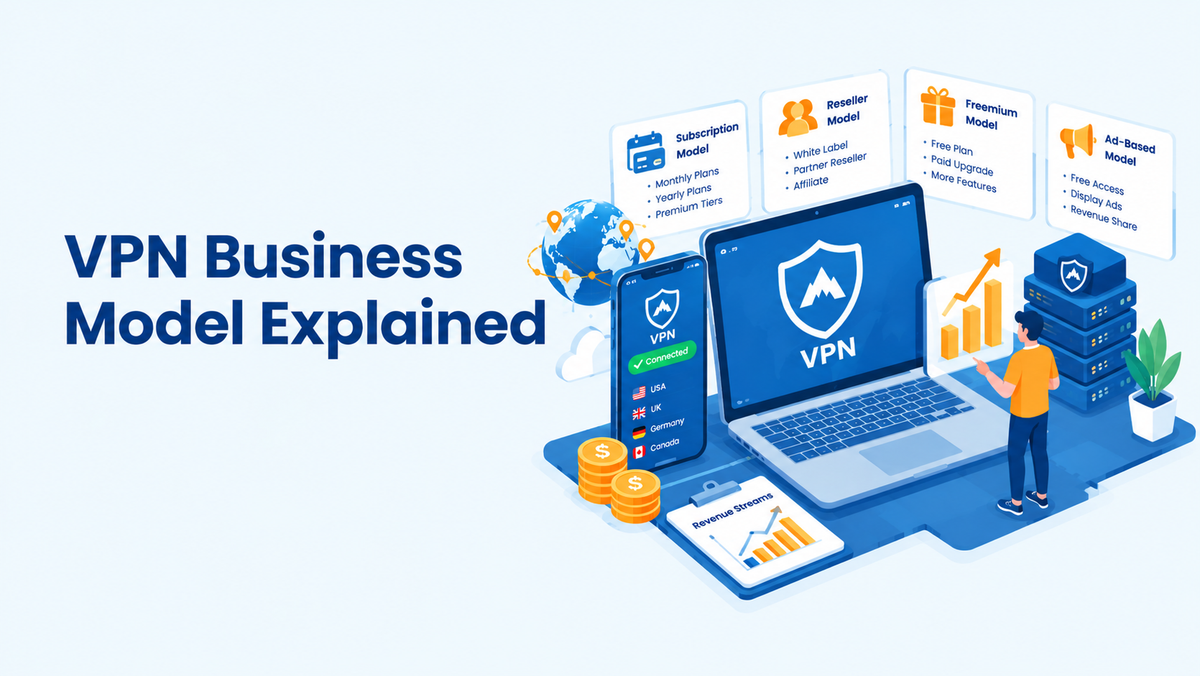
Subscription Model
The subscription model is the backbone of the VPN industry — recurring monthly or annual billing in exchange for full-featured access. Providers like NordVPN, ExpressVPN, and Surfshark built billion-dollar valuations almost entirely on this model.
How It Works Technically
Subscription VPNs typically run a tiered server architecture: entry-level infrastructure on shared bare-metal or virtual private servers (VPS) for standard traffic, and dedicated high-throughput nodes (often WireGuard-based for lower latency and leaner codebase) for premium tiers. Billing is handled through recurring payment gateways (Stripe, Paddle, or in-app billing via Apple/Google), with license validation tied to device-count entitlements enforced at the authentication server.
Business Analysis
The economics hinge on Customer Lifetime Value (LTV) vs. CAC. Annual plans with heavy upfront discounts (a common industry tactic — 70-80% off "list price") are actually a customer acquisition strategy: providers accept a lower first-year margin to lock in a 12-month non-cancellable revenue stream, betting on auto-renewal at full price. The real profit driver isn't the sale — it's the renewal rate. A VPN with a 40% renewal rate and $3/mo effective pricing can out-earn a competitor with a 25% renewal rate at $5/mo.
Where Enova VPN can stand out: Instead of racing to the bottom on discount depth, Enova VPN can compete on transparent renewal pricing (no bait-and-switch pricing jump at renewal) — a trust signal that directly reduces chargebacks and improves renewal rate, which matters more to long-term profitability than the initial conversion rate.
Freemium Model
The freemium model offers a functional, rate-limited free tier to drive volume, with a paid upgrade path for full speed, unlimited data, or premium server locations.
Technical Constraints of a Free Tier
Running a free tier is not "the same product, just capped." It requires a separate cost-control architecture: bandwidth throttling at the edge (usually via traffic shaping on the load balancer, not the app), a smaller pool of shared servers to concentrate free-tier load and protect paid-tier latency, and stricter rate limiting on server-switching to prevent abuse (e.g., users cycling IPs for scraping or fraud). Free tiers are also the highest-risk surface for abuse and reputation damage — spam, credential stuffing, and scraping traffic routed through free VPN IPs can get entire IP ranges blacklisted, which then degrades service for paying users on shared infrastructure.
The Conversion Funnel Economics
Freemium only works if the funnel math holds up: industry benchmarks put SaaS-style freemium-to-paid conversion at roughly 2–5%. That means a freemium VPN needs a low marginal cost per free user (cheap bandwidth, low support burden) to avoid subsidizing non-converting users into a loss. The model is fundamentally a CAC-reduction strategy — free users replace paid-ad spend with word-of-mouth and organic app-store discovery — not a standalone revenue model.
Where Enova VPN can stand out: Cap the free tier on speed and server choice, not core privacy features (encryption, no-logs). Users increasingly distrust free VPNs on privacy grounds; Enova VPN can use full-strength encryption on the free tier as a trust-building acquisition tool, then monetize convenience (speed, location choice, streaming-optimized servers) rather than security itself.
Reseller Model
In the reseller model, third parties (often IT consultancies, regional ISPs, or influencers) buy VPN access in bulk at wholesale rates and resell it under their own pricing — sometimes under their own brand via light customization, sometimes as a straightforward affiliate-adjacent resale.
How It Works Technically
Resellers are typically issued API-driven provisioning access: a reseller dashboard that lets them generate and manage license keys or sub-accounts programmatically, with usage reporting rolled up for wholesale billing reconciliation. This requires Enova VPN to build (or license) a multi-tenant account management layer on top of the core VPN infrastructure — something many smaller VPN providers underestimate the engineering cost of.
Business Analysis
Resellers effectively become a distributed sales force at zero direct CAC to the core provider — the provider trades margin (wholesale discount, often 30-50% off retail) for scale without ad spend. The risk is channel conflict and brand dilution: if reseller pricing undercuts direct pricing significantly, it cannibalizes higher-margin direct subscribers.
Where Enova VPN can stand out: Segment the reseller channel toward underserved regional markets where Enova VPN doesn't have direct marketing presence, rather than competing head-on with its own direct-sales channel — turning resellers into market expansion rather than a discount leak.
Ad-Based Model
Here, the VPN is offered free of charge and monetized through advertising — either in-app ads or (more controversially) bandwidth/data monetization.
The Technical and Ethical Line
There are two very different technical implementations that get lumped under "ad-based," and the distinction matters enormously for trust:
- In-app advertising — standard ad SDK integration, no different from any free mobile app, with no compromise to the VPN tunnel itself.
- Traffic-based monetization — historically, some free VPNs have monetized by selling aggregated (allegedly anonymized) user traffic data or bandwidth to third parties. This model has repeatedly triggered regulatory action and reputational collapse (e.g., past FTC actions against free VPN providers) because it directly contradicts the core value proposition of a VPN: privacy.
Business Analysis
Ad-supported VPNs generally have the lowest ARPU (Average Revenue Per User) of any model in this list, since mobile ad eCPMs are volatile and low relative to subscription revenue. It only works at massive scale (millions of MAUs) with very low infrastructure cost per user.
Where Enova VPN can stand out: If Enova VPN uses an ad-supported free tier at all, it should be strictly limited to option 1 (in-app ads, zero traffic monetization) and this should be stated explicitly and audited — turning a commonly distrusted model into a differentiated trust claim: "we monetize attention, never your data."
Pay-as-You-Go Model
Pay-as-you-go (PAYG) charges users based on actual usage — data consumed, session time, or connection count — rather than a flat recurring fee.
How It Works Technically
This requires real-time (or near-real-time) usage metering at the tunnel level — tracking bytes transferred per session per user, typically via accounting hooks in the VPN daemon (common with OpenVPN's --management interface or WireGuard's handshake/transfer counters) feeding into a billing ledger. Prepaid-credit systems are common to avoid billing disputes over usage measurement.
Business Analysis
PAYG appeals to low-frequency, high-trust-sensitivity users — travelers, journalists, or occasional torrenting/streaming users who don't want a recurring commitment. Revenue is inherently less predictable than subscriptions (harder to forecast MRR), but it captures a customer segment that would otherwise churn immediately or never convert from a subscription funnel at all.
Where Enova VPN can stand out: Offer PAYG as a complementary, not competing, tier — positioned explicitly for specific use cases (e.g., "30-day trip pass," "streaming weekend pass") rather than as a generic pricing option, which both simplifies the buying decision and increases average transaction value versus a plain per-GB meter.
B2B Model (For Business VPN)
Business VPN sells not to individual consumers but to organizations needing secure remote access, site-to-site connectivity, or team-wide privacy infrastructure.
Technical Requirements Are a Different Product
B2B VPN is not "consumer VPN with a bulk discount" — it requires materially different infrastructure:
- Centralized admin console for provisioning/deprovisioning employee access tied to HR offboarding workflows
- SSO/SAML and directory integration (Okta, Azure AD, Google Workspace) for enterprise identity management
- Dedicated IP and static routing options for whitelisting against internal enterprise firewalls
- SLA-backed uptime guarantees (often 99.9%+) with contractual penalties, which changes the entire infrastructure redundancy and monitoring investment required
- Audit logging for compliance (SOC 2, HIPAA, GDPR data-processing agreements) — a direct tension with the "no-logs" marketing consumer VPNs rely on, requiring careful architectural separation between consumer and business product logging policies
Business Analysis
B2B contracts carry dramatically higher ARPU and LTV than consumer subscriptions (often 10-50x per seat annually) with far lower churn — enterprise contracts are typically annual with procurement friction that naturally reduces cancellation. The tradeoff is a much longer sales cycle and the need for dedicated account management and support SLAs, which raises the cost-to-serve per customer significantly compared to self-serve consumer signups.
Where Enova VPN can stand out: B2B is the highest-margin, most defensible model in this entire list if Enova VPN is willing to build the compliance and admin tooling — it's also the model competitors under-invest in because it's harder to build. A mid-market focus (50-500 employee companies, underserved by enterprise-only VPN vendors) is a realistic wedge.
White-Label Model
White-labeling lets other companies license Enova VPN's underlying technology and infrastructure and rebrand it entirely as their own product — distinct from reselling because the end customer never sees the Enova VPN name at all.
How It Works Technically
This demands a fully white-labelable client architecture: configurable app branding (name, logo, color scheme) built into the client build pipeline, a backend that supports multi-brand tenant isolation (so brand A's users and brand B's users are logically separated even on shared server infrastructure), and often a dedicated API layer the licensee's own developers can build against if they want a custom UI rather than a reskinned app.
Business Analysis
White-label is a B2B2C infrastructure-licensing play — Enova VPN earns recurring licensing or per-seat wholesale fees while the licensee owns the customer relationship, marketing, and support burden. It's a way to monetize infrastructure investment (server network, protocol engineering) without the cost of consumer marketing. Margins per user are lower than direct-to-consumer, but customer acquisition cost is effectively zero since the licensee handles all of it.
Where Enova VPN can stand out: White-labeling turns Enova VPN's server network into a B2B infrastructure product, similar to how AWS monetizes infrastructure other companies build on top of. This is a strong path if Enova VPN's core technical differentiation (server speed, network footprint) is stronger than its consumer brand recognition today.
Affiliate Model
The affiliate model pays commissions to publishers, YouTubers, and content creators for referring paying customers — the dominant customer acquisition channel across the entire consumer VPN industry, not merely a side revenue stream.
How It Works Technically
This runs on attribution infrastructure: tracked referral links or coupon codes tied to an affiliate dashboard, cookie- or fingerprint-based attribution windows (typically 30-90 days), and payout automation tied to confirmed (non-refunded, non-chargeback) conversions rather than raw clicks.
Business Analysis
Affiliate commissions in the VPN industry are notoriously high — often 40-100% of first-month or first-year revenue — because CAC through paid search and social ads has become extremely expensive in this category. This effectively makes affiliates a performance-based CAC channel: Enova VPN only pays when a sale actually converts, shifting acquisition risk from the company to the affiliate. The danger is incentive misalignment — affiliates optimizing purely for commission can drive low-intent, high-churn signups (via misleading "best VPN" review sites), which looks like growth but actually degrades LTV:CAC ratio.
Where Enova VPN can stand out: Weight affiliate commissions toward retention, not just first conversion (e.g., partial commission paid out at the 3-month or 6-month renewal mark) — this single structural change filters out low-quality affiliate traffic naturally, since affiliates optimizing for short-term clicks won't earn as much as those driving genuinely satisfied long-term customers.
How Enova VPN Can Help?
Given the above, no single model is inherently "correct" — the strongest VPN businesses run a blended stack, not a single model:
- Subscription as the core consumer revenue engine, with transparent renewal pricing as a differentiator.
- Freemium as a low-cost acquisition funnel, monetizing convenience rather than gating core privacy.
- Affiliate, weighted toward retention-based payouts, as the primary paid-performance acquisition channel.
- B2B, as the long-term margin and defensibility play, built deliberately rather than as an afterthought.
- White-label and reseller, as capital-efficient ways to monetize the underlying server network without direct marketing spend.
Enova VPN's advantage isn't just technical (protocol choice, server footprint, speed) — it's in choosing which of these models to run well rather than spreading thin across all eight. The technical infrastructure decisions above (multi-tenant billing, admin consoles, metering, white-label build pipelines) each represent real engineering investment, so sequencing matters: validate the consumer subscription core first, then layer B2B and white-label once the underlying network and trust reputation are proven.
Conclusion
The VPN market is not short on encryption strength or server counts — it's short on business model discipline. Providers that treat "VPN business" as synonymous with "subscription app" leave significant revenue and defensibility on the table, while providers that chase every monetization model at once dilute their engineering focus and brand trust.
For Enova VPN, the opportunity is to be deliberate: build a strong subscription core, use freemium and affiliate channels as disciplined acquisition tools rather than blunt-force growth hacks, and treat B2B and white-label as the long-term moat that most consumer-facing VPN competitors are too under-resourced to build well. That combination — technical rigor paired with monetization discipline — is what turns a VPN app into a durable VPN business.